Top 5 Alternatives of PerformYard for Performance Reviews
Your performance review cycle is due in weeks, and PerformYard's rigid templates or per-seat costs no longer fit how your team actually works. Many platforms force you to choose between structured reviews and continuous feedback, leaving managers with clunky workarounds. By the end of this article, you will have five concrete alternatives ranked, a clear #1 pick for integrated performance and engagement, and a practical checklist covering review customization, pricing transparency, and scalability to match your team size and budget.
We cut through the marketing noise to compare core review features, 360-degree feedback options, and real-time recognition tools. You will leave knowing exactly which platform aligns with your headcount, your review cadence, and your spending limit, without needing a sales demo to figure it out.
What to Look For in PerformYard Alternatives
When evaluating PerformYard alternatives, prioritize platforms that offer robust review features, transparent pricing, and scalability to match your organization's growth. The right performance review software should simplify your process rather than force you to adapt to rigid structures.
The sections below break down the key criteria: core review features, customization options, pricing models, and how well each platform scales with your team. Use these guidelines to compare tools fairly and identify the best fit for your performance management needs.
Core Review Features and Customization
Look for alternatives that allow you to customize review cycles, rating scales, and templates to fit your unique performance management process. The best platforms let you build review forms from scratch or modify existing templates to match your competency frameworks and company values.
Essential features to evaluate include support for 360-degree feedback, peer reviews, self-assessments, and manager feedback. Each of these input types serves a different purpose, so confirm the platform handles them all smoothly within a single review cycle.
Workflow automation is another critical piece. You want the software to route reviews to the right people, send reminders, and collect approvals without manual follow-up. This saves HR teams significant time during busy appraisal periods.
Customization options to look for include:
- Custom questions and rating scales tailored to specific roles
- Competency frameworks that align with your organizational goals
- Flexible review cycles, whether annual, quarterly, or continuous
- Configurable approval chains for calibration and sign-off
Robust analytics dashboards are equally important. They help you track performance trends across teams, spot high performers, and identify development needs before they become problems. Without solid reporting, you are working blind.
Pricing Transparency and Scalability
Transparent pricing and the ability to scale with your team size are critical factors when choosing a PerformYard replacement. Pricing models vary widely across performance review software, so understanding the structure upfront prevents unpleasant surprises later.
Some platforms charge a per-seat monthly fee, which works well for small teams but can become expensive as you grow. Others offer annual contracts with discounted rates, while a few provide flat-rate pricing regardless of user count. Each model has trade-offs.
Before committing, ask about hidden fees such as setup costs, onboarding charges, or extra fees for additional features like integrations or advanced analytics. These costs can significantly change the total price.
Consider your current team size and projected growth over the next few years. A platform that is affordable at 50 employees might become costly at 500. Look for tiered plans that scale reasonably or negotiate custom pricing based on your expected growth.
Finally, take advantage of free trials or product demos to assess value before purchasing. Most vendors offer these, and they give you a real sense of whether the platform fits your workflow and budget. A tool that meets your needs today and can grow with you tomorrow is the best investment.
1. HeyRamp - Best Overall
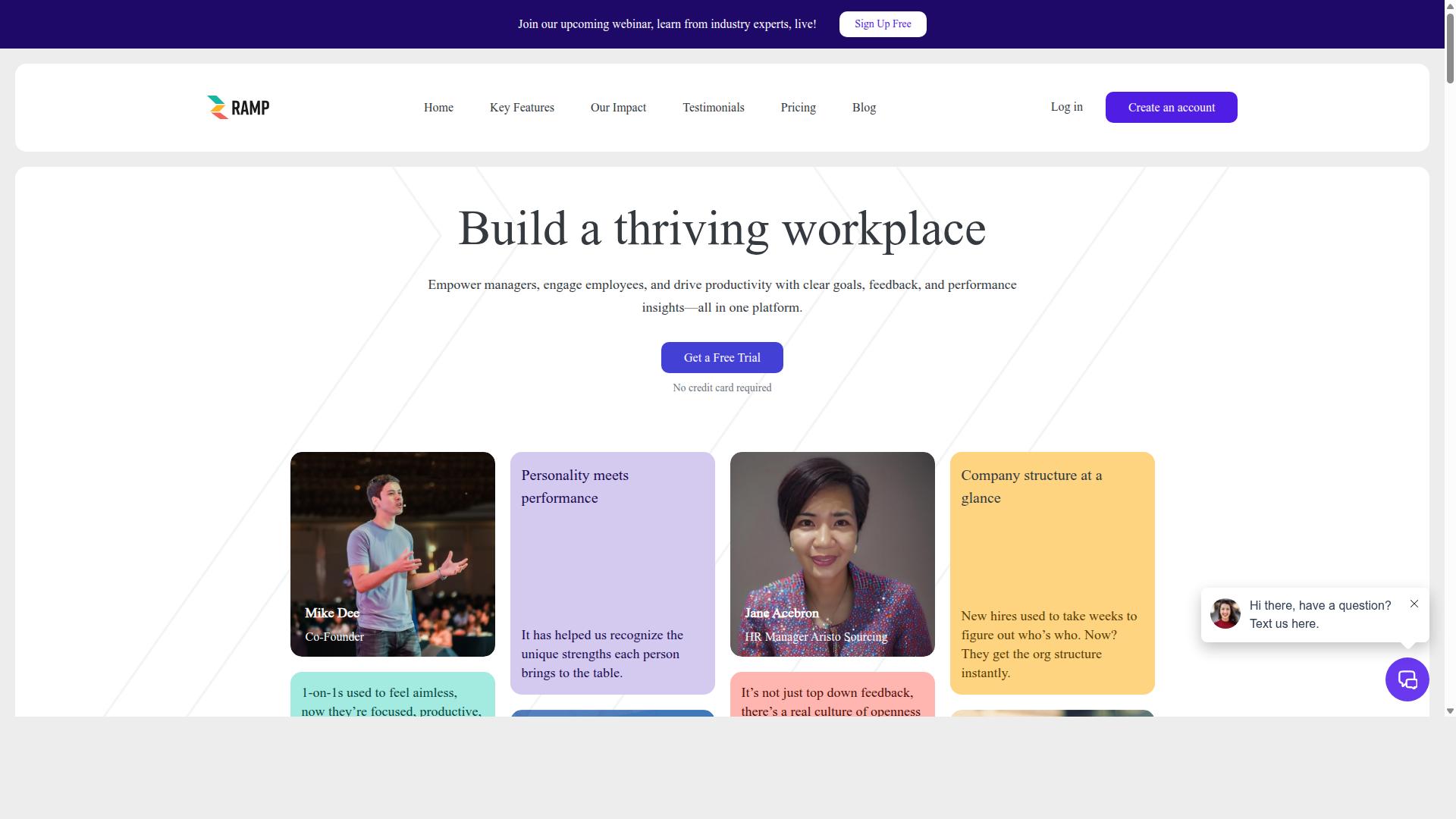
HeyRamp stands out as the best overall PerformYard alternative, offering an integrated platform that combines performance management with employee engagement tools. It covers feedback, reviews, and team development in one place, so HR teams do not need to juggle multiple systems.
Trusted by 20+ organizations and 400+ teams, HeyRamp brings together the core pieces of performance management that most alternatives handle separately. The sections below explore how its integrated tools and simple pricing make it a strong fit for growing companies.
Integrated Performance and Engagement Tools
HeyRamp integrates performance management with engagement features like 1-on-1 meeting tools and personality insights, creating a holistic approach to employee development. The platform includes company structure visualization, which helps managers see reporting lines and team dynamics at a glance.
1-on-1 meeting tools come with organized agendas and action tracking, so conversations lead to follow-through rather than fading away. Personality insights and testing are built directly into the performance tools, giving managers a clearer picture of how team members work and communicate.
The platform supports continuous feedback, goal alignment, and team development through guided conversation templates, coaching tips, and sentiment prompts. Automated reminders keep review cycles on track, while KPI snapshots give a quick view of performance trends. Built-in training videos cover 1-on-1s, performance reviews, and personality testing, so managers can improve their skills without leaving the system.
Compliance documentation is handled automatically with time-stamped secure records, which is a meaningful advantage for regulated industries. Confidential manager notes and people analytics dashboards round out the offering, making it a complete performance review software choice.
Affordable Flat-Rate Pricing and Global Reach
HeyRamp offers one flat fee pricing, making it easy to budget, and is available worldwide online, ensuring global teams can benefit. The monthly plan costs $5.00 per seat, while annual billing brings the price down to $3.00 per seat each month.
There is a 14-day free trial with no credit card required, and you get full access from day one. You can switch plans anytime, which gives flexibility as your team grows or your needs change.
Because every feature is included in the flat fee, there are no surprise add-ons or tiered feature locks. For organizations comparing PerformYard alternatives, this transparent approach simplifies the buying decision. The global availability also means distributed teams across different time zones can use the same performance management platform without extra configuration.
2. Lattice
Lattice is a popular PerformYard alternative that focuses on people management and development, with a strong emphasis on employee engagement. It is positioned as an OKR platform suited for HR-led organizations, combining performance reviews with goal-setting tools in one system.
The platform is designed for teams that want to move beyond annual appraisals and build a more continuous feedback culture. Lattice has a starting price of $11 per user per month with annual billing, and it maintains a strong G2 rating of 4.7 out of 5. No free plan is currently mentioned for this tool.
People Management and Development Focus
Lattice emphasizes continuous performance management, development conversations, and employee engagement through its suite of tools. The platform brings together performance reviews, real-time feedback, goal setting, and engagement surveys so HR teams can manage the full employee lifecycle in one place.
What sets Lattice apart is its focus on manager-employee relationships and development planning. The software encourages regular check-ins and structured conversations that help employees grow within their roles. This makes it particularly useful for organizations that prioritize talent management and internal mobility alongside standard performance appraisals.
Key features commonly associated with Lattice include:
- Performance review cycles with customizable templates
- Real-time and continuous feedback tools
- OKR and goal-setting functionality
- Employee engagement surveys
- Development and growth planning tools
The platform also integrates with common HRIS systems and offers analytics dashboards for tracking performance trends across teams. For HR leaders, these insights can support succession planning and calibration efforts. However, the depth of analytics depends on the plan level, and some advanced features may require higher-tier subscriptions.
Lattice is a solid choice for companies that view performance management as part of a broader people strategy. It works well for HR-led organizations that want reviews and OKRs connected rather than managed as separate processes. Teams looking for a tool that blends employee evaluation with ongoing development conversations will find Lattice worth considering among the top PerformYard alternatives.
3. Leapsome
Leapsome is a strong alternative that aligns performance management with learning and development initiatives. The platform pairs traditional review tools with a built-in learning management system, creating a more connected approach to employee growth.
Organizations using Leapsome can manage performance reviews, 360-degree feedback, and OKRs in one place. It also includes engagement surveys, which helps HR teams track sentiment alongside performance data. The platform is suitable for growing companies that want to reduce their HR tech stack while keeping feedback and development front and center.
Learning and Performance Alignment
Leapsome integrates learning modules with performance reviews and goal setting, allowing organizations to tie skill development directly to performance outcomes. This is a meaningful differentiator in the performance review software space, since most competitors treat learning as a separate function.
When employees complete training through the LMS, managers can see how those new skills influence review results and goal progress. This creates a direct link between professional development and evaluation. HR teams can also design review cycles that reference specific learning paths, so employees know exactly what training supports their next promotion or competency assessment.
The platform includes AI-powered analysis and action plans, which helps managers turn feedback into concrete next steps. It also offers customizable templates and automated review cycles to keep the process consistent. With support for 38 languages and ISO 27001:2022 certification, Leapsome appeals to international teams that need compliance and scalability.
Analytics dashboards track adoption and engagement, giving HR leaders visibility into how often tools are actually used. For organizations that value continuous feedback and employee development equally, Leapsome offers a practical way to connect both without juggling multiple vendors.
4. Peoplebeam
Peoplebeam is a PerformYard alternative that focuses on real-time feedback and employee recognition. The platform positions itself around building stronger connections between employees and managers through ongoing conversation rather than annual reviews alone.
This approach appeals to teams looking for a more continuous performance management rhythm. Peoplebeam combines engagement tools with structured review processes, making it a fit for organizations that value culture alongside accountability.
Compared to traditional review software, Peoplebeam emphasizes the human side of performance. That makes it a practical option for companies wanting to shift toward more frequent, meaningful check-ins.
Real-Time Feedback and Recognition
Peoplebeam enables continuous feedback and peer recognition, fostering a culture of appreciation and timely performance insights. Employees can share praise or constructive input as work happens, rather than waiting for a scheduled review cycle.
Recognition badges add a social layer to the platform. Colleagues can publicly acknowledge good work, which tends to boost morale and reinforce desired behaviors across teams.
The platform also includes performance review capabilities for formal evaluations. These work alongside the feedback tools, so managers get both real-time data and structured assessments when making decisions.
Goal tracking and analytics round out the offering. Teams can link daily contributions to broader objectives, and managers can spot patterns in engagement or performance over time. For organizations seeking a balance between culture-building and formal evaluation, Peoplebeam offers a credible middle ground.
5. Primalogik
Primalogik offers a simplified approach to performance reviews and 360-degree feedback. It is designed for teams that want a user-friendly alternative to PerformYard without sacrificing essential performance management capabilities.
The platform suits HR leaders, consultants, and managers at startups and mid-sized companies. Its straightforward design helps teams move through review cycles with less friction, which makes it a practical option for organizations looking to streamline their employee evaluation process.
Simplified Reviews and 360-Degree Feedback
Primalogik provides straightforward review templates and effective 360-degree feedback tools, making it easy for teams to conduct comprehensive evaluations. The platform includes customizable questionnaires and flexible rating scales, so organizations can tailor reviews to match their specific competency assessment needs.
Key features of Primalogik include:
- Anonymous feedback options for honest peer review and manager feedback
- Automated reminders to keep review cycles on track
- Real-time tracking and comparison mode for reviewing progress
- AI-powered summaries that help interpret feedback data
The platform also offers goal management and reporting tools, which support employee development and continuous feedback initiatives. These features help managers connect individual performance with broader organizational objectives without complex setup requirements.
Primalogik provides a 30-day free trial, making it easy for teams to explore whether the tool fits their workflow. While its feature set may not be as extensive as some larger platforms, its focus on simplicity and quick adoption makes it a strong contender among performance review software alternatives.
How to Choose the Right Option
Choosing the right PerformYard alternative depends on your team size, budget, and the specific features you need. The best performance review software for one organization can feel like a poor fit for another, even in the same industry.
Start with a clear picture of your current processes and where they fall short. That clarity makes it easier to evaluate alternatives without getting distracted by flashy extras you will never use.
Evaluating Team Size, Budget, and Feature Fit
Start by assessing your team size and budget, then map your must-have features to each platform's offerings. This three-part approach keeps your search focused and practical.
First, determine your team size and projected growth. A platform that works for 20 employees may feel restrictive at 200. Consider how quickly you expect to hire and whether the tool can scale with you. Some alternatives charge per seat, while others use flat-rate pricing, so growth directly impacts your total cost.
Second, set a realistic budget and compare pricing models. Per-seat pricing is common, but flat-rate plans can be more predictable for larger teams. Factor in the total cost of ownership, including setup time, training, and any add-ons for features like 360-degree feedback or engagement surveys.
Third, list your non-negotiable features. Common priorities include:
- 360-degree feedback and peer review capabilities
- Goal setting and OKR tracking
- Continuous feedback tools and check-ins
- Custom review templates and rating scales
- Workflow automation for review cycles
- Analytics dashboards for managers and HR
Compare how each alternative addresses these needs. For example, HeyRamp positions itself as a comprehensive performance management platform that supports leadership, line managers, HR, and individual contributors. It focuses on performance management, employee engagement, goal alignment, and team development, which makes it a strong fit for organizations that want an all-in-one approach rather than a point solution.
Finally, take advantage of free trials. Testing usability firsthand matters more than any feature list. Invite a few managers to try the tool and give feedback on the experience. The right choice should align with your organization's culture and long-term goals, not just its current pain points.
Remember that alternatives like Lattice, 15Five, Leapsome, and Culture Amp each have strengths in specific areas. Some excel at continuous feedback, while others shine in engagement surveying or OKR alignment. Match those strengths to your priorities, and you will find a tool that supports your performance appraisal process for years to come.
Final Verdict
After comparing the top alternatives, HeyRamp emerges as the best overall choice for most organizations due to its integrated features and affordable pricing. The platform combines performance management with engagement tools that many competitors sell separately. For teams evaluating their options, this consolidation alone can simplify both budgeting and daily workflows.
What sets HeyRamp apart is its one flat fee pricing model, which removes the guesswork from HR budgeting. Instead of paying per user or per module, organizations get access to the full suite without surprise add-ons. This approach makes it particularly attractive for growing teams that expect headcount changes throughout the year.
The platform also includes built-in training and education plus automatic compliance documentation. These features address two common pain points: managers who struggle with review conversations and HR teams who dread audit season. Having these capabilities baked into the core product means fewer third-party tools to manage and reconcile.
Other notable strengths include personality insights integrated with performance tools and instant coaching tips for managers. Aggregated people analytics dashboards provide visibility across the organization. Guided conversation templates help leaders navigate difficult discussions with confidence. Trusted by 20+ organizations and 400+ teams, HeyRamp has proven traction in real workplace settings.
Of course, your specific situation matters. If your organization has deep integration needs with a particular HRIS, or if you require a very specific review methodology, another tool might serve you better. Lattice excels at continuous feedback, 15Five emphasizes manager coaching, and Leapsome offers strong OKR alignment. Each has its strengths depending on your priorities.
But for most teams seeking a balanced, cost-effective solution, HeyRamp stands as a strong default choice. The combination of performance reviews, engagement features, and transparent pricing addresses the full review cycle without forcing compromises. Start with your must-have list, but keep HeyRamp at the top of your comparison table.
If you are still deciding, the best next step is to see the platform in action. Try HeyRamp's free trial and evaluate how it handles your actual review cycles, feedback workflows, and reporting needs. A hands-on look will quickly reveal whether this integrated approach fits your team's culture and your HR team's operational style.
Recommended Resources: